Owned product
Making an uncomparable category comparable.
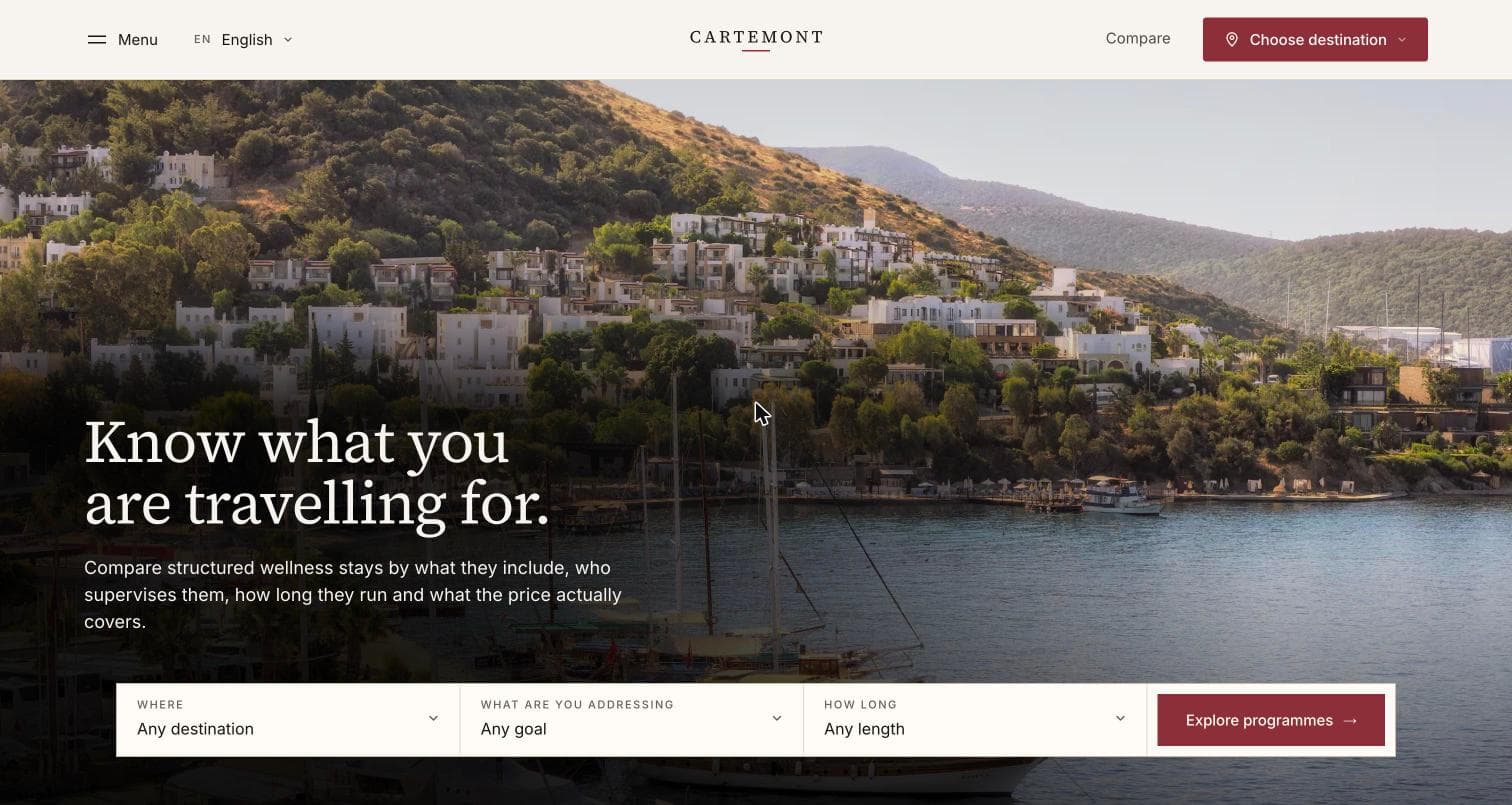
Cartemont compares structured wellness programmes by what they include, who supervises them, how long they run and what the price actually covers. It is Relay Atelier's own product, live in seven languages.
- Product
- Cartemont
- Sector
- Wellness and health travel
- Year
- 2026
- Live product
- cartemont.com
Context
Wellness travel is a category where the information a buyer needs in order to decide is systematically missing. Programme pages are written in incompatible shapes, what the price covers is frequently left vague, and the question of who supervises the programme often goes unanswered entirely.
The problem
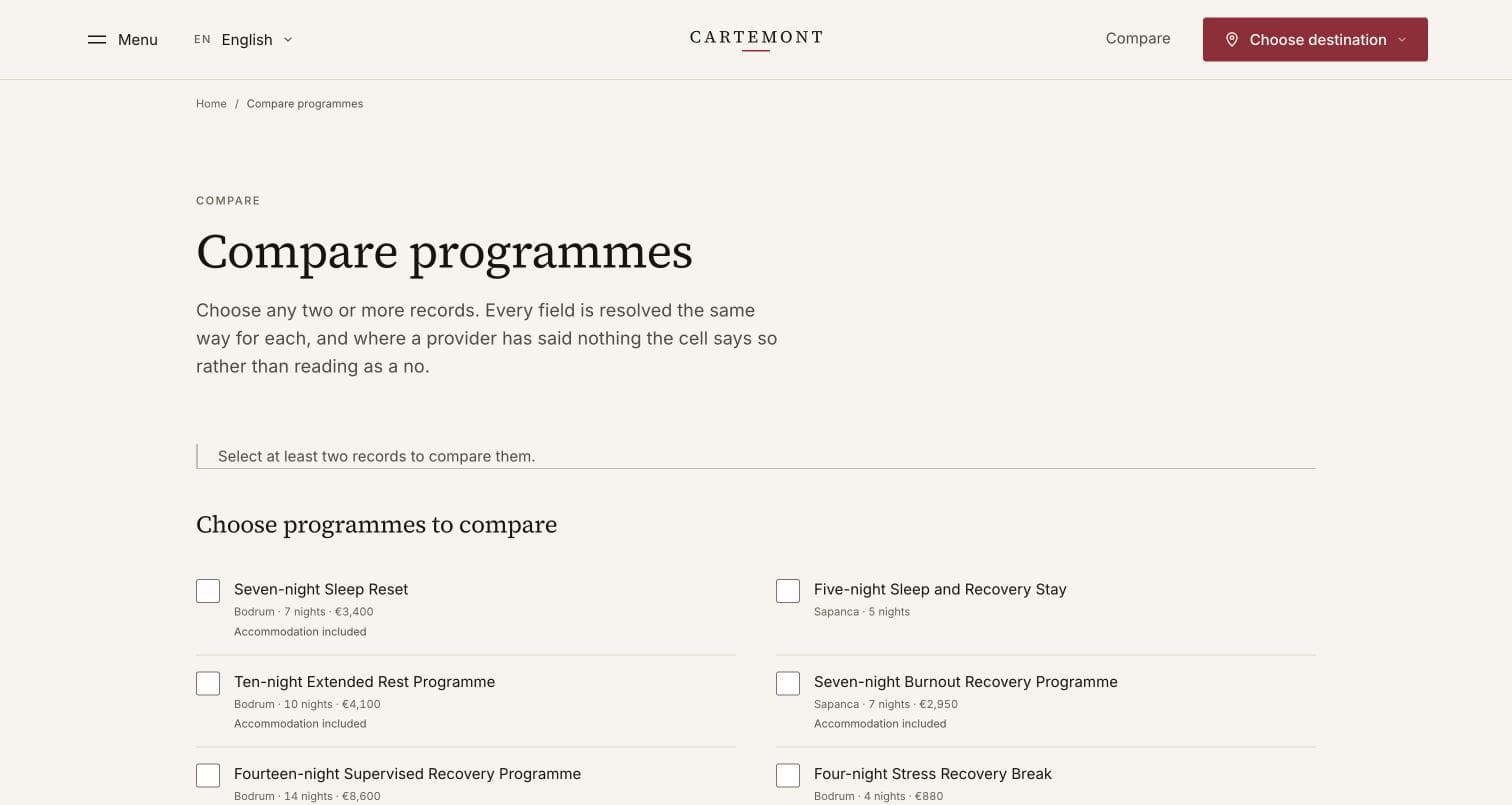
Comparison here is a harder problem than collecting the data: most providers don't fill in the same fields. A provider who left a field blank and a provider who answered 'no' are not the same thing — but most comparison interfaces render them identically. That is a quiet error that misleads the person relying on it.
The system
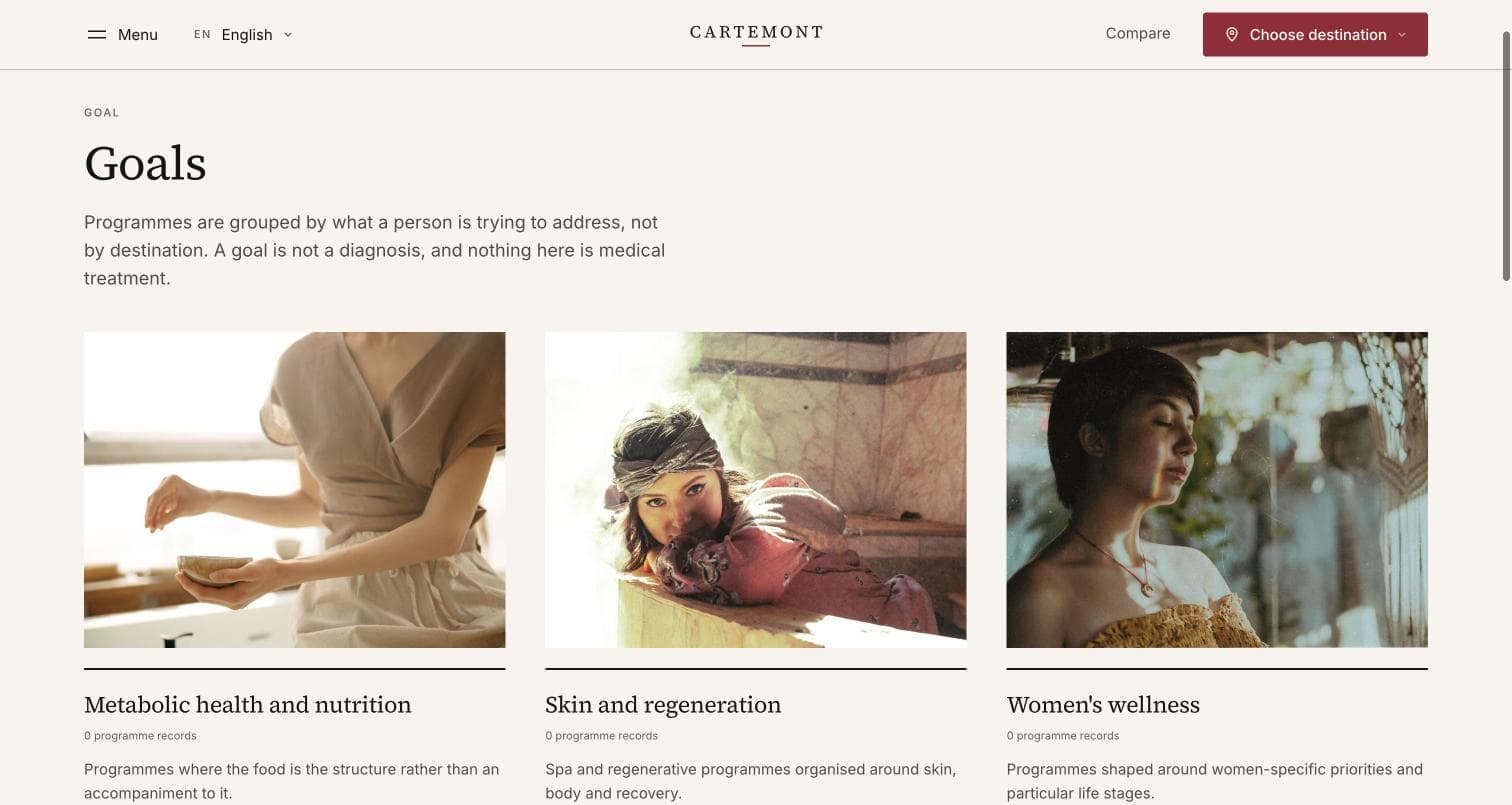
A catalogue where programme records sit on a shared schema, group under a goal-based taxonomy, and are compared field by field. The comparison rule is published on the face of the product: where a provider has said nothing, the cell says so rather than reading as a no. The category's limit is published the same way — a goal is not a diagnosis, and nothing listed is medical treatment.
Implementation
We defined the schema first: which fields have to be present before a programme can be called comparable at all. Then we wrote and published what the word 'checked' means in this product, because a verification claim without a definition is a marketing sentence. Seven languages were built in from the start; the content structure was designed as something that stands up in each language rather than as a translation layer over one.
What's live today
- The platform is live at cartemont.com.
- Seven languages: English, Turkish, German, Russian, Spanish, Portuguese and French.
- 26 published pages per language — 182 URLs in the sitemap.
- Eight goal categories: metabolic health, skin, women's wellness, sleep, stress, movement, longevity and biohacking.
- A field-level comparison interface that renders 'not stated' as its own value rather than as a no.
- The verification standard and the category's limits are published on the product's own pages.
What we delivered
Strategy and product
- Product definition, category and scope
- Programme data schema and comparison rules
- Goal taxonomy and destination structure
Brand and interface
- Brand system and editorial visual language
- Comparison, catalogue and goal interfaces
- Responsive design and typographic system
Content infrastructure
- Seven-language content structure and routing
- Editorial guide library
- Writing and publishing the verification standard
Engineering
- Frontend and platform development
- Multilingual routing, hreflang and sitemap
- Production infrastructure and deployment
Technology
- Next.js
- React
- TypeScript
- Structured content model
- Multilingual routing and hreflang
- Vercel
No user, partner, booking or revenue figures appear on this page. Everything written here can be checked against the live platform.
Getting started
Where are you losing enquiries?
Tell us about the enquiry that goes unanswered, the follow-up done by hand, or the work that scatters between systems. In the first call we'll establish what can be systematised and where to start.
After you send the form
- A reply within two working daysWe read your message and suggest a time that suits you.
- A 30–45 minute discovery callA working session that maps the process, not a sales pitch. If it isn't a fit, we'll say so plainly.
- A written summaryAfterwards we put in writing what could be built, in what order, and within what scope.