Owned product
One product for the whole listing-media operation.
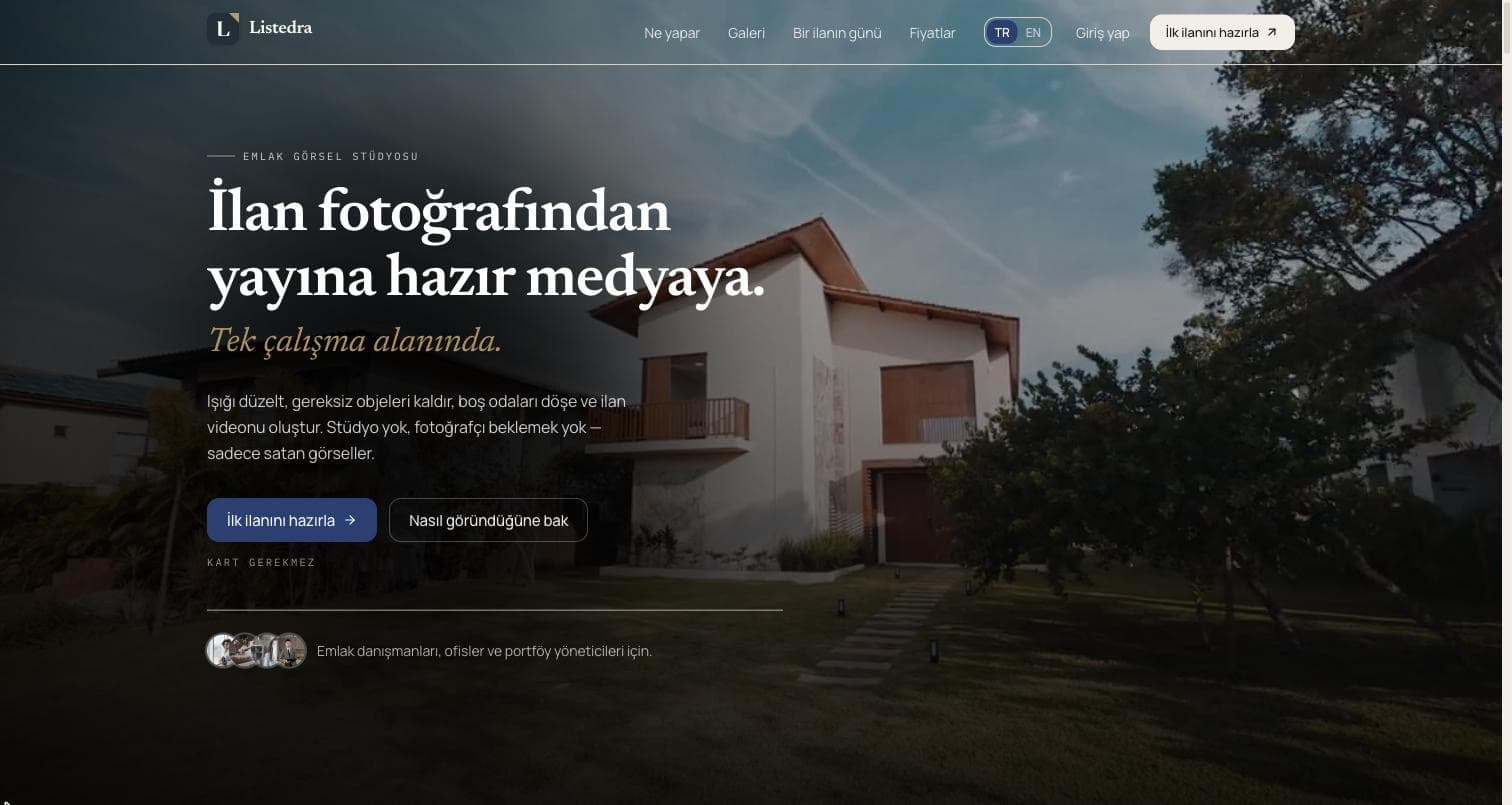
Listedra is the workspace real-estate professionals use to prepare listing media. Relay Atelier defined the product, built its brand and interface, developed the bilingual application and took it to production.
- Product
- Listedra
- Sector
- Real estate
- Year
- 2026
- Live product
- listedra.com
The problem
Preparing the images for one listing means moving between several tools. When enhancement, virtual staging, object removal, comparison, portfolio work and video each happen somewhere else, files, versions and exports scatter quickly. A large share of the time goes into carrying the work between tools rather than doing it.
Context
For the agent, office or portfolio manager preparing a listing, getting the images ready isn't one job — it's a series of jobs that were never connected to each other. This product didn't start with a client brief; it started as a studio decision. The only way to show we can define and ship a product end to end was to do it.
The system
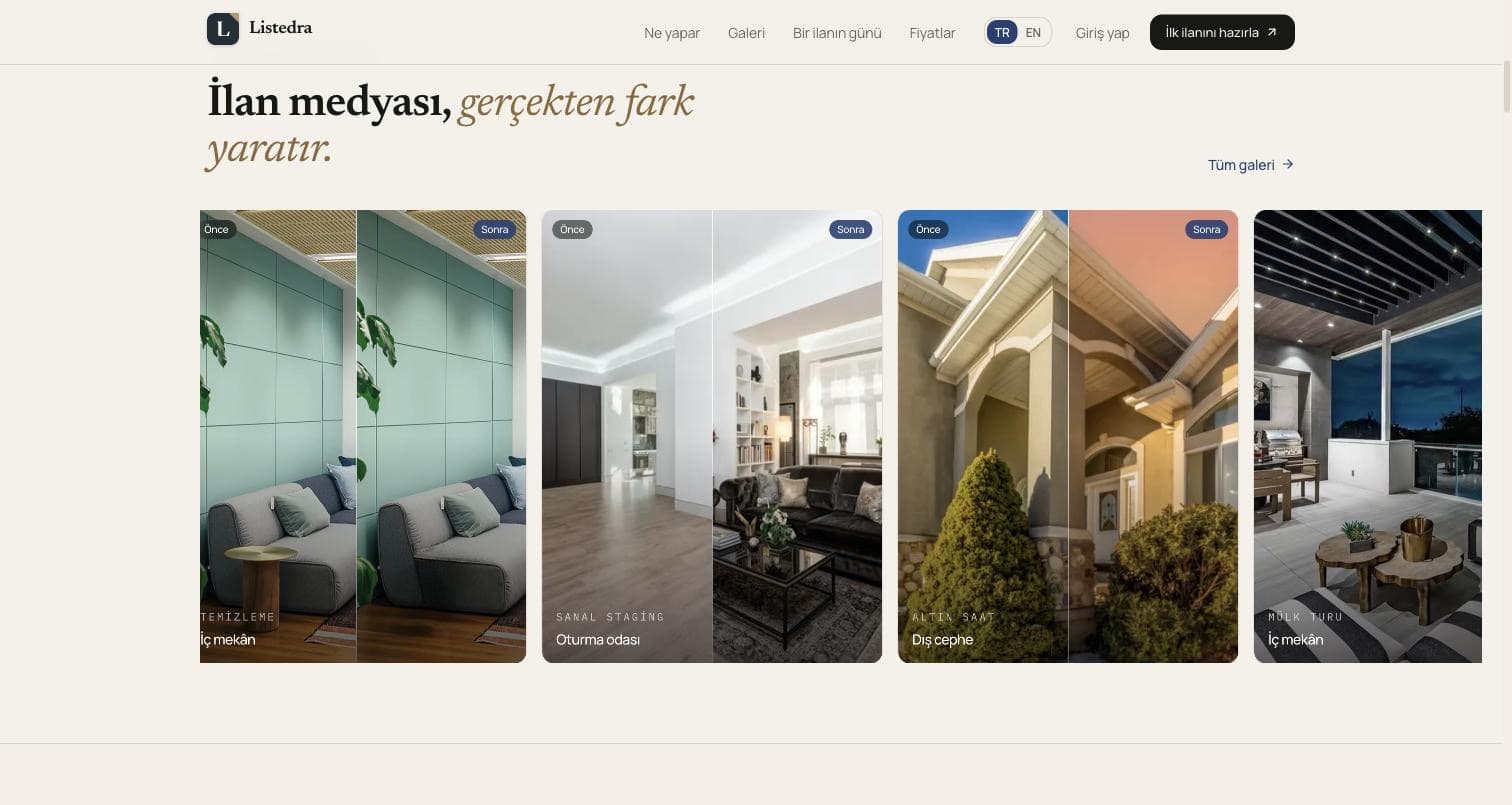
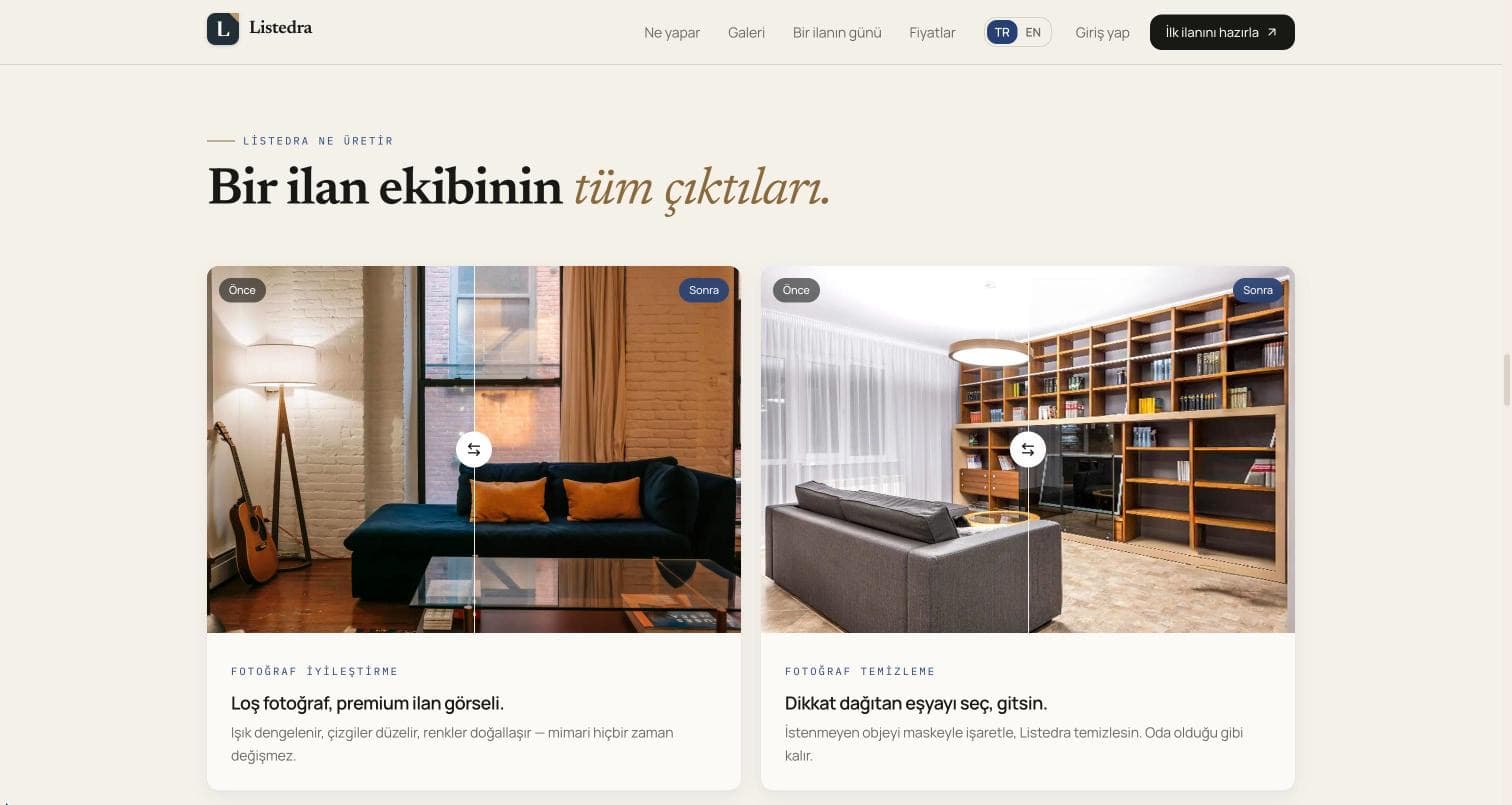
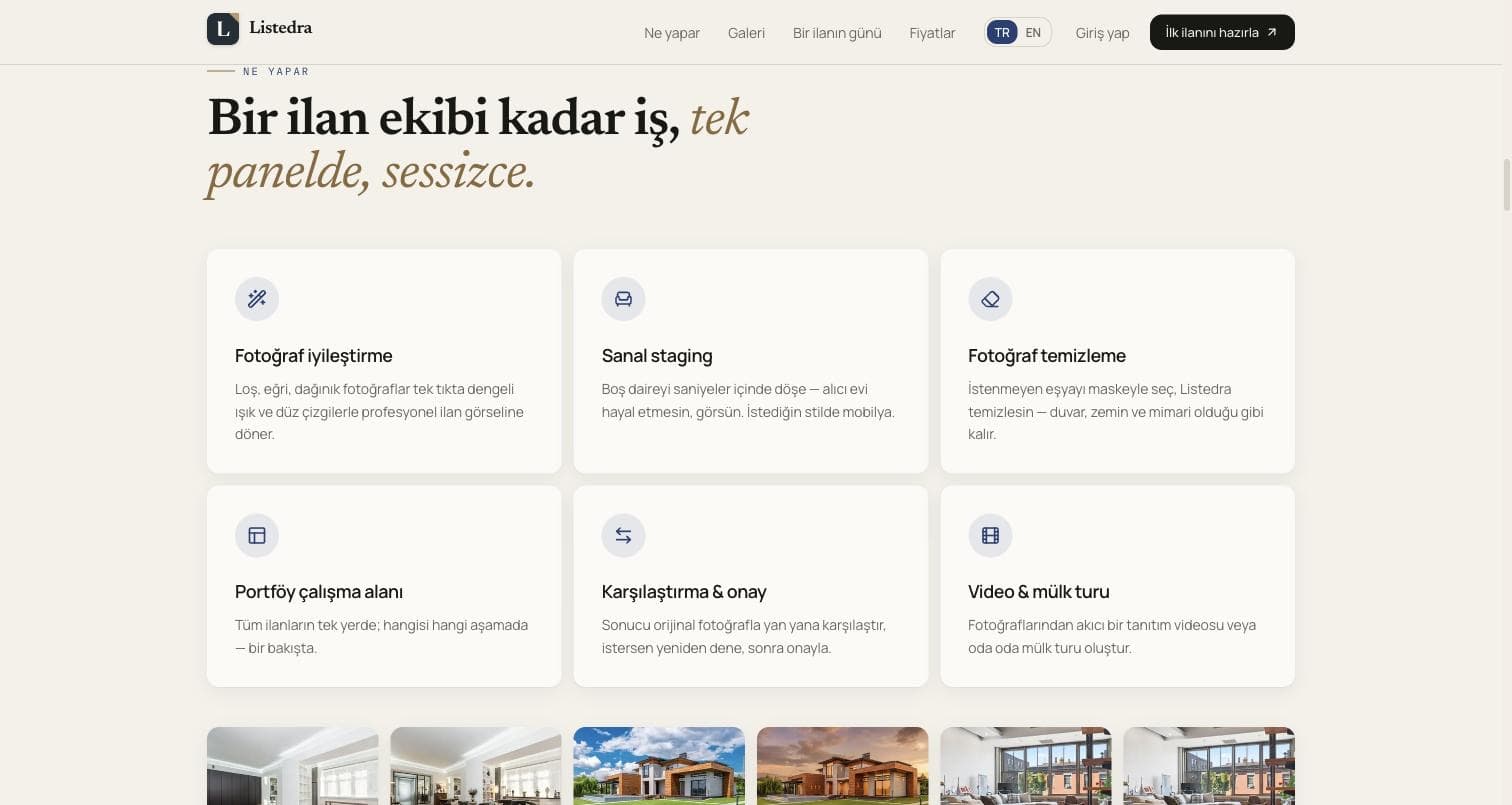
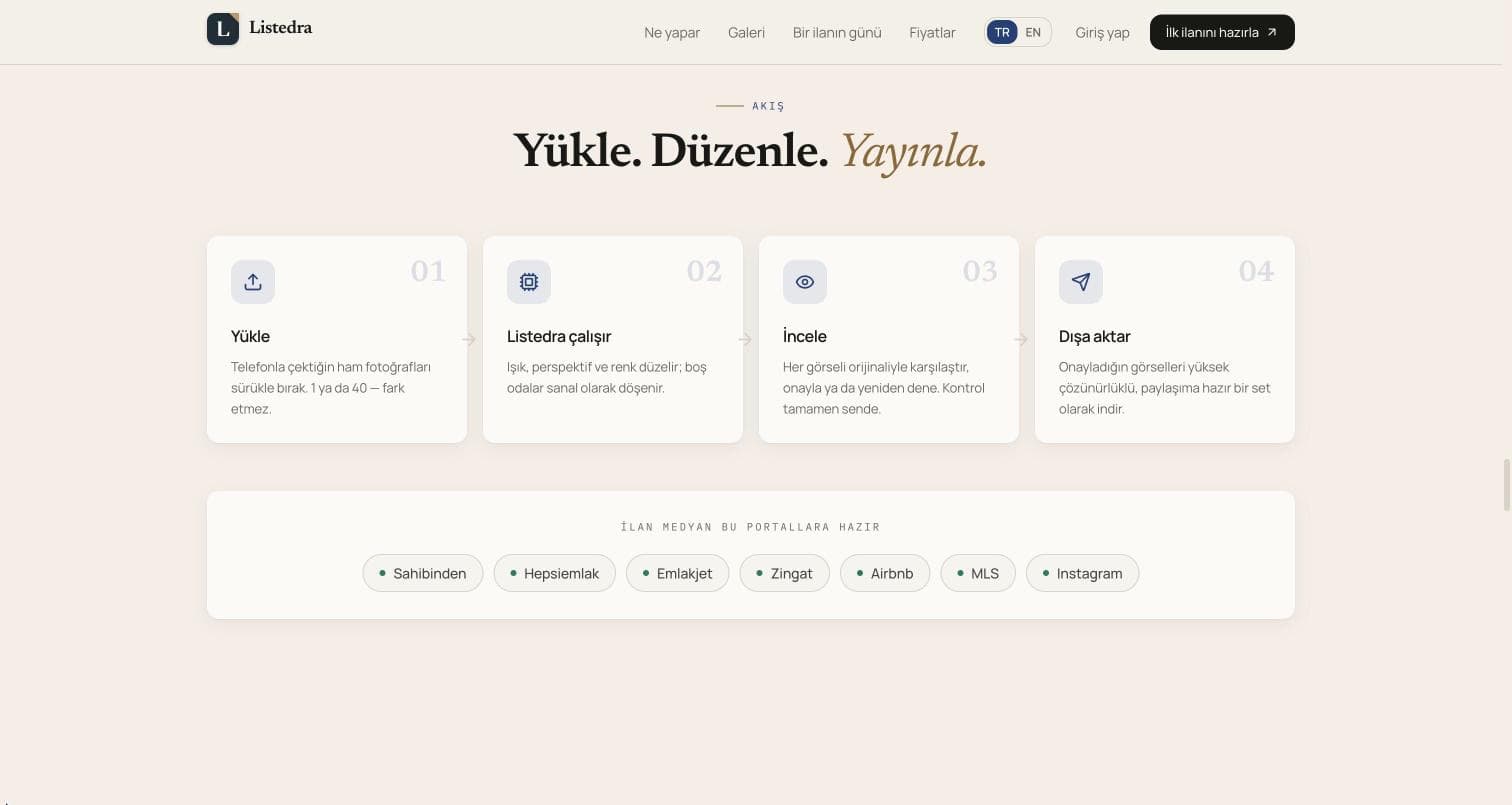
A single workspace that puts six capabilities on one file and version model. Someone signs in with a Google account, uploads the photographs, applies the operations in sequence, and exports in the shape the listing portals expect. The product's constraint is part of the system too: the image can be improved and the space can be presented, but the structure itself cannot be altered.
What we delivered
Strategy and product
- Product definition and scope
- Product decisions and constraints
- Pricing and plan structure
Brand and interface
- Brand system and visual language
- UX/UI design and product interface
- Responsive marketing and product screens
Engineering
- Frontend and product development
- Authentication and Google OAuth
- Production infrastructure and deployment
AI and media
- Image and video generation workflows
- Implementation of architectural-preservation constraints
Launch and quality
- Turkish and English localisation
- Testing, QA and the production launch
Implementation
We built Listedra to bring that scattered workflow into a single workspace. The constraint came first — architectural preservation — because it determined what the product legally and commercially was; the generation pipelines were then designed around it. Brand, interface and marketing screens were built by the same team, alongside the product. The bilingual structure wasn't retrofitted; it was there from the start.
What's live today
- The product is live and public at listedra.com.
- Six capabilities in one product: enhancement, virtual staging, object removal, portfolio, before/after comparison and video.
- Fully localised in Turkish and English.
- Account creation and session handling via Google OAuth.
- The architectural-preservation constraint is enforced at the product level.
Technology
- Next.js
- React
- TypeScript
- Google OAuth
- Image and video generation models
- Object storage
- Vercel
No user, revenue or conversion figures appear on this page. Everything shown can be checked against the live product.
Getting started
Where are you losing enquiries?
Tell us about the enquiry that goes unanswered, the follow-up done by hand, or the work that scatters between systems. In the first call we'll establish what can be systematised and where to start.
After you send the form
- A reply within two working daysWe read your message and suggest a time that suits you.
- A 30–45 minute discovery callA working session that maps the process, not a sales pitch. If it isn't a fit, we'll say so plainly.
- A written summaryAfterwards we put in writing what could be built, in what order, and within what scope.